Learn how to use the Free Fire Training Ground as a beginner. Practice aiming, movement, weapon control, and Gloo Wall placement with a simple routine.
Free Fire Training Ground Guide
The Free Fire Training Ground is a useful place to practice your skills before entering a real match. Instead of learning every movement or weapon during a fight, you can use practice sessions to become more familiar with aiming, movement, weapon handling, and defensive actions.
For beginners, the goal is not to copy a professional player’s movements immediately. It is to build control, improve consistency, and understand how your chosen settings work.
In this Free Fire Training Ground guide for beginners, you will learn how to access the practice area, what to practice first, how to build a simple daily routine, and how to identify the mistakes that may be holding you back.
What Is the Free Fire Training Ground?
The Free Fire Training Ground, also known as the Training Grounds or training area, is a practice environment where players can explore available training activities and improve their familiarity with the game’s mechanics.
Depending on the current game version and available training options, you may be able to practice with weapons, aim at targets, test movement, experiment with controls, and work on defensive techniques.
It is useful for both new and experienced players because you can focus on a specific skill without making every practice attempt part of a competitive match.
Remember that the available activities, layout, and menu names can change after game updates.
How to Enter the Free Fire Training Ground
Follow these general steps to look for the training area:
- Open Free Fire and wait for the main lobby to load.
- Check the available game modes or mode-selection menu.
- Look for Training, Training Grounds, or a similarly named option.
- Select the mode if it is available and enter the training area.
- Explore the available practice sections before beginning your routine.
The exact steps may vary between Free Fire versions, regions, and updates. If you cannot find the option, check the current in-game menus and official game announcements.
Once you enter, spend a few minutes understanding the layout. Find the available target areas, weapon options, and other practice activities before trying complicated drills.
What Should Beginners Practice First?
Trying to improve every skill in one session can make practice confusing. Start with a few fundamentals and add more challenging exercises as you become comfortable.
1. Practice Basic Movement
Movement helps you reposition, reach cover, avoid predictable patterns, and navigate the battlefield.
Start by practicing simple actions:
- Move forward, backward, left, and right.
- Change direction without losing control.
- Move while turning the camera.
- Practice stopping and starting smoothly.
- Learn to move toward available cover without becoming disoriented.
Once these actions feel comfortable, combine them. For example, move sideways while keeping your camera directed toward a target.
Avoid rushing through the exercise. Smooth, controlled movement is more useful than moving quickly while repeatedly losing track of your target.
2. Practice Aiming at Targets
Aim practice helps you understand how your crosshair responds to movement and firing inputs.
Begin with stationary targets if the training area offers them.
Try this simple exercise:
- Position your crosshair near the center of a target.
- Fire a short burst or use controlled shots, depending on the weapon.
- Observe where your shots land.
- Reset your aim and repeat.
- Gradually introduce movement while aiming.
Pay attention to consistency rather than counting only successful hits. If your crosshair repeatedly moves past the target, slow down and practice smaller adjustments.
When you become comfortable with stationary targets, try moving targets if they are available.
For more detailed advice, read our guide on how to improve your aim in Free Fire.
3. Learn Basic Weapon Control
Different weapons can feel different because of their firing behavior, range, recoil, and handling characteristics.
Rather than switching between every available weapon, choose one familiar weapon and learn how it behaves.
Practice these steps:
- Fire controlled bursts when appropriate for the weapon.
- Observe how your crosshair moves during sustained firing.
- Pause between attempts and reset your aim.
- Compare close-range and longer-range performance where possible.
- Try another weapon only after you understand the first one.
Do not assume that one weapon or firing technique works equally well at every distance. Your results will depend on the weapon, the target, the range, and your control.
The objective is to understand your chosen weapon instead of changing equipment after every unsuccessful attempt.
4. Practice Crosshair Placement
Crosshair placement means keeping your aim near the area where you expect a target to appear.
If your crosshair is consistently directed at the ground, you may need to make a larger adjustment when an opponent appears. Practicing a comfortable, target-ready position can reduce unnecessary camera movement.
Try the following drill:
- Choose a target or a fixed point.
- Move away while maintaining control of your camera.
- Turn back toward the target.
- Bring your crosshair onto it with a controlled movement.
- Repeat from different directions.
As you improve, practice maintaining a useful crosshair position while moving between targets.
Do not focus exclusively on headshots at the beginning. First learn to position your crosshair reliably, then work on precision.
5. Practice Gloo Wall Placement
Gloo Walls can provide temporary cover during a fight. Learning to select and place one deliberately can help you respond more confidently when you need protection.
If the training area provides a suitable space and the required equipment, practice this basic sequence:
- Identify the direction from which you want cover.
- Select the Gloo Wall using your current controls.
- Place it where intended.
- Check whether it provides the cover you expected.
- Move to a safer position and return to your normal controls.
Repeat the sequence until you can perform each step without accidentally selecting another action.
After basic placement becomes familiar, practice combining a Gloo Wall with movement and repositioning. Focus on placing the wall in the intended direction rather than attempting advanced tricks immediately.
For a more comfortable button arrangement, see our Free Fire HUD layout guide for beginners.
6. Test Your Sensitivity Settings Carefully
Training is also a useful opportunity to understand how your sensitivity settings affect camera movement and aiming.
If your aim frequently moves past the target, your sensitivity may feel too high for that movement. If turning toward a target feels difficult, your settings may feel too slow for your current control technique.
However, sensitivity is only one part of aiming. Your finger movement, device, frame rate, and familiarity with the controls can also affect your results.
Use this testing method:
- Start with your current sensitivity settings.
- Practice the same aiming drill several times.
- Identify one specific problem.
- Adjust only the relevant setting slightly, if needed.
- Repeat the same drill under similar conditions.
- Keep the change only if it feels more controllable.
Avoid changing multiple sensitivity values after every unsuccessful attempt. Consistent testing makes it easier to understand which adjustment actually helps.
Read our guide to Free Fire sensitivity settings for beginners for more detailed advice.
A Simple 15-Minute Free Fire Training Routine
Beginners do not need to spend hours in the training area to make each session useful. A short routine can help you focus on a few important skills.
Use this optional 15-minute plan as a starting point.
| Time | Practice Activity | Main Goal |
|---|---|---|
| 3 minutes | Basic movement and camera control | Move smoothly and stay oriented |
| 4 minutes | Stationary target practice | Improve crosshair control |
| 3 minutes | Weapon handling | Understand firing behavior |
| 3 minutes | Gloo Wall placement | Practice defensive actions |
| 2 minutes | Review your weakest skill | Choose the next practice goal |
These timings are suggested, not official game presets. Adjust them according to your needs and the activities available in your version of Free Fire.
If aiming is your biggest challenge, spend more time on target practice. If you frequently struggle to place a Gloo Wall correctly, dedicate more time to that action instead.
The purpose of a routine is to give your practice direction, not to force every player to follow the same schedule.
How to Know Whether Your Practice Is Improving
It can be difficult to judge progress if you only ask whether you won your next match.
Instead, look for small, observable improvements:
- You can bring your crosshair onto a target with less unnecessary movement.
- You miss fewer control inputs during familiar actions.
- You can move and aim without losing track of your target as often.
- You can place a Gloo Wall in the intended direction more consistently.
- You understand which settings or actions are causing a particular problem.
- You can repeat a drill with similar results across multiple attempts.
You do not need to improve every skill in every session. Identify one recurring problem and use your next practice session to work on it.
Afterward, play a regular match and focus on applying that one skill. A training drill can help build familiarity, but real matches still require positioning, decision-making, awareness, and adaptation.
Common Free Fire Training Ground Mistakes
Practicing Without a Goal
Moving between weapons and activities without a clear objective can make it difficult to identify progress.
What to do instead: Choose one or two skills before entering the training area.
Changing Sensitivity Too Frequently
Repeatedly changing settings makes it harder to determine whether an adjustment has helped.
What to do instead: Test one small change at a time and repeat the same exercise.
Trying Advanced Techniques Too Early
Complicated movement combinations can become frustrating when basic controls are not yet comfortable.
What to do instead: Master the individual actions first, then combine them gradually.
Practicing Only Stationary Aiming
Stationary targets are useful for learning crosshair control, but actual matches involve movement, changing distances, and unexpected situations.
What to do instead: Start with stationary targets and progress to moving targets or movement-based drills when available.
Expecting Immediate Results
A short session will not automatically transform your gameplay. Some skills require repeated practice before they become reliable.
What to do instead: Compare your performance over multiple sessions and look for consistent improvements.
Ignoring Your Control Layout
A button that is difficult to reach can interrupt an otherwise familiar action.
What to do instead: Review your HUD if you repeatedly miss the same input. Change one control at a time and practice with the new arrangement before making further adjustments.
Training Ground vs. Real Matches: What Is the Difference?
The training area and regular matches serve different purposes.
Training lets you isolate particular mechanics and repeat them. Real matches require you to combine those mechanics with decision-making, positioning, resource management, and awareness of other players.
For example, you can practice placing a Gloo Wall in a controlled environment, but using it effectively in a match also depends on where the opponent is, how much cover is available, and whether you need to reposition.
A practical approach is to warm up in the training area, play a match while focusing on one skill, and then review what felt difficult.
This connects practice with real gameplay without expecting every training exercise to translate into an immediate win.
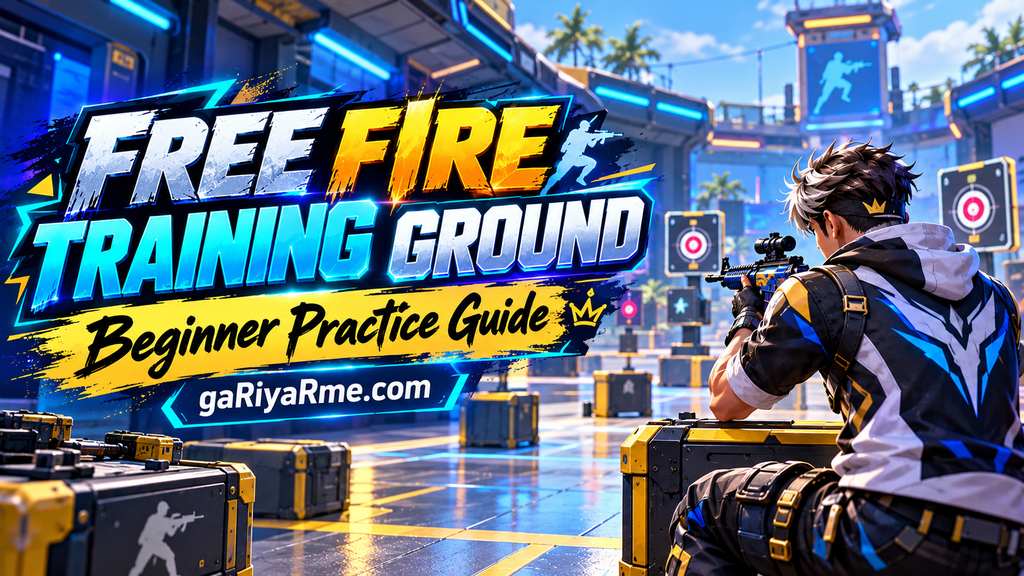
The Free Fire Training Ground can help beginners become more familiar with aiming, movement, weapon handling, and defensive actions. The most useful approach is to practice with a clear goal instead of attempting every technique at once.
Start with basic movement and aiming, introduce weapon control and Gloo Wall placement, and test your settings carefully when necessary. Use a short routine that fits your schedule and review one recurring mistake after each session.
Most importantly, combine practice with regular matches. Training helps you repeat individual actions, while real gameplay teaches you when and how to use them.
With consistent, focused practice, you can develop better control and make more informed decisions as you continue learning Free Fire.
Frequently Asked Questions
1. What is the Free Fire Training Ground?
The Free Fire Training Ground is a practice environment where players can explore available training activities and work on skills such as aiming, movement, and weapon handling. The available activities may vary by game version.
2. How do I enter the Free Fire Training Ground?
Open Free Fire, check the mode-selection menu, and look for Training or Training Grounds. Menu names and access steps can change, so check the current in-game options if you cannot find it.
3. How long should beginners practice in Free Fire?
A 10–15-minute session can be a practical starting point. Focus on a few specific skills and adjust the duration to your needs rather than following a rigid schedule.
4. Can the Training Ground help improve aim?
Yes. Repeating controlled aiming exercises can help you become more familiar with crosshair movement and weapon behavior. Improvement also depends on consistent practice and applying those skills in real matches.
5. Should I change my sensitivity settings in the Training Ground?
You can use practice sessions to test whether your current settings feel controllable. Change one setting at a time, repeat the same exercise, and avoid assuming that a particular sensitivity value will work for every player.
6. Can I practice Gloo Wall placement in the Training Ground?
If the relevant training activity and equipment are available in your current game version, you can practice selecting and placing Gloo Walls. Start with accurate placement before attempting faster combinations.
7. Is the Training Ground enough to become a better Free Fire player?
No single practice environment covers every part of gameplay. Training can help you work on individual mechanics, while regular matches help you apply those skills to positioning, awareness, and decisions under pressure.
8. What should I practice first as a beginner?
Start with basic movement, camera control, and aiming at stationary targets. Once these feel more comfortable, add weapon handling, movement-based aiming, and Gloo Wall placement.
Leave a Reply