
What is a shooting game? Learn the meaning, types, features, gameplay mechanics, weapons, multiplayer modes, FPS, third-person shooters, and Battle Royale games in this beginner-friendly guide.
What Is a Shooting Game?
A shooting game is a type of video game in which shooting, aiming, ranged combat, and weapon-based gameplay are major parts of the experience.
In a shooting game, players may control a character, vehicle, or other playable unit and use different weapons to defeat enemies, complete missions, survive battles, or compete against other players.
Shooting games can be single-player or multiplayer and may include different gameplay styles such as first-person shooting, third-person shooting, tactical combat, Battle Royale, team-based matches, and more.
Because shooting is such a flexible gameplay mechanic, shooting games can be combined with other genres including RPG, survival, open-world, strategy, and action games.
How Does a Shooting Game Work?
The basic gameplay loop of a shooting game often looks like this:
Explore → Find or Select Weapons → Aim → Shoot → Defeat Enemies → Complete Objectives → Progress
However, every shooting game does not follow exactly the same structure.
Some games focus on fast-paced combat, while others emphasize strategy, teamwork, exploration, survival, or story.
For example, a single-player shooting game may revolve around missions and a story, while a multiplayer shooting game may focus on matches between players.
Main Features of Shooting Games
Shooting games can contain many different features depending on their design.
1. Weapons
Weapons are usually one of the most important elements of a shooting game.
A game may include:
- Pistols
- Assault rifles
- Shotguns
- Sniper rifles
- Submachine guns
- Machine guns
- Bows
- Energy weapons
- Explosive weapons
- Special weapons
Different weapons can have different damage, range, accuracy, fire rate, reload speed, and handling.
2. Aiming and Shooting
Aiming is another core mechanic.
Players generally need to aim at an enemy or target before firing. Some games reward precision, while others focus more on fast movement and reaction time.
Depending on the game, aiming may include:
- Hip firing
- Aim-down-sights
- Scope systems
- Crosshairs
- Lock-on targeting
- Precision shooting
3. Enemies
Shooting games can include different types of enemies.
These may include:
- AI-controlled enemies
- Other players
- Bosses
- Soldiers
- Creatures
- Vehicles
- Special enemies
Enemy design can significantly affect the difficulty and strategy of a game.
4. Health and Damage
Many shooting games use a health system.
A player may lose health after being attacked. Some games also include armor, shields, healing systems, or protective equipment.
Weapon damage may depend on factors such as:
- Weapon type
- Distance
- Hit location
- Armor
- Enemy type
5. Maps and Environments
Maps play an important role in shooting games.
A game may feature:
- Cities
- Military bases
- Forests
- Deserts
- Buildings
- Islands
- Space stations
- Underground locations
- Open-world environments
Map design can influence movement, positioning, combat, and strategy.
Types of Shooting Games
Shooting games are not a single uniform genre. They can be divided into several different formats.
1. First-Person Shooter (FPS)
A First-Person Shooter, commonly called an FPS, is played primarily from the first-person perspective.
The player usually sees the game world from the character’s viewpoint and often sees the weapon in front of them.
FPS gameplay commonly emphasizes:
- Aiming
- Shooting
- Movement
- Reaction time
- Weapon control
- Combat
FPS games can be single-player or multiplayer.
2. Third-Person Shooter
A Third-Person Shooter uses an external camera that allows players to see their character.
This perspective can make character movement and positioning more visible.
Third-person shooters may combine shooting with:
- Cover systems
- Character abilities
- Exploration
- Melee combat
- Vehicles
- Open-world gameplay
3. Multiplayer Shooting Games
Multiplayer shooting games allow multiple players to participate in the same game environment.
Players may compete against each other or cooperate as a team.
Common multiplayer formats include:
- Team vs Team
- Free-for-all
- Ranked matches
- Casual matches
- Cooperative missions
- Competitive matches
Our guide to What Is a Multiplayer Game? explains the broader concept of multiplayer gaming.
4. Battle Royale Shooting Games
Many Battle Royale games use shooting as their primary combat system.
Players typically enter a large map, collect weapons and equipment, fight opponents, and try to become the last player or team remaining.
A shrinking safe zone is often used to push players toward encounters.
You can learn more in our complete guide:
5. Tactical Shooting Games
Tactical shooting games put greater emphasis on planning, positioning, teamwork, and decision-making.
Players may need to carefully consider:
- Position
- Team coordination
- Weapon selection
- Map knowledge
- Timing
- Enemy movement
Unlike purely fast-paced shooting, tactical games may reward patience and strategic thinking.
6. Hero-Based Shooting Games
Some shooting games combine gunplay with unique playable characters.
Different characters may have different:
- Abilities
- Weapons
- Roles
- Movement systems
- Special powers
This creates a combination of shooting mechanics and character-based gameplay.
7. Vehicle-Based Shooting Games
Some games combine shooting with vehicle combat.
Players may use:
- Cars
- Tanks
- Aircraft
- Boats
- Futuristic vehicles
Vehicle combat can become an important part of the game’s overall mechanics.
Shooting Game vs FPS: Are They the Same?
No.
A shooting game is a broad category, while FPS describes a specific type of shooting game based primarily on the first-person perspective.
For example, shooting games can be:
- First-person
- Third-person
- Tactical
- Multiplayer
- Battle Royale
- Vehicle-based
- Single-player
So:
Every FPS can be a shooting game, but not every shooting game is an FPS.
Shooting Game vs Battle Royale
A shooting game and a Battle Royale game do not mean exactly the same thing.
A shooting game is primarily defined by its shooting or ranged-combat mechanics.
A Battle Royale game is defined by a particular competitive survival format involving multiple players, a large play area, limited resources, and usually a shrinking playable zone.
Many Battle Royale games are also shooting games.
Therefore, Battle Royale and shooting game can overlap, but they are not interchangeable terms.
Single-Player vs Multiplayer Shooting Games
Shooting games can be designed around either single-player or multiplayer experiences.
Single-Player Shooting Games
Single-player shooting games generally place the player against AI-controlled enemies.
They may include:
- Story campaigns
- Missions
- Objectives
- Boss fights
- Character progression
- Exploration
Multiplayer Shooting Games
Multiplayer shooting games involve other human players.
They may include:
- Matchmaking
- Team play
- Ranked matches
- Competitive modes
- Voice communication
- Multiplayer progression
Some games offer both single-player and multiplayer modes.
Common Shooting Game Mechanics
Shooting games can use many gameplay mechanics.
Aim
Players aim their weapon toward a target.
Reloading
Weapons may need to be reloaded after ammunition is used.
Recoil
Some weapons produce recoil, making them harder to control during continuous firing.
Accuracy
Weapon accuracy can determine how consistently shots hit the intended target.
Damage
Different weapons can cause different amounts of damage.
Headshots
Some games provide additional damage when players hit specific areas such as the head.
Cover
Players may use walls, buildings, objects, or terrain for protection.
Movement
Running, crouching, jumping, sliding, or other movement systems can influence combat.
Health and Armor
Players may have health, armor, shields, or other defensive systems.
What Makes a Shooting Game Fun?
A good shooting game usually combines several elements effectively.
Responsive Controls
The controls should feel responsive and predictable.
Satisfying Gunplay
Weapons should feel distinct and provide clear feedback when used.
Balanced Gameplay
Weapons, characters, abilities, and maps should be reasonably balanced.
Interesting Maps
Good maps provide different tactical opportunities.
Meaningful Progression
Unlocks, achievements, upgrades, or other progression systems can encourage players to continue.
Engaging Competition
In multiplayer games, fair matchmaking and balanced competition can make matches more enjoyable.
Are Shooting Games Always About Guns?
No.
Although firearms are common in shooting games, the genre does not necessarily require traditional guns.
Depending on the game’s setting, players may use:
- Bows
- Energy weapons
- Futuristic weapons
- Fantasy projectiles
- Special abilities
- Other ranged weapons
The important concept is ranged or shooting-based combat, not necessarily the use of real-world firearms.
Can Shooting Games Be Multiplayer?
Yes.
Multiplayer shooting games are extremely popular.
They can support formats such as:
- 1v1
- Team vs Team
- Free-for-all
- Cooperative missions
- Battle Royale
- Ranked matches
- Casual matches
Some games also support cross-platform multiplayer, allowing players on different platforms to play together.
For a broader explanation of multiplayer gaming, see:
Shooting Games on Mobile
Shooting games are also popular on mobile devices.
Mobile shooting games may use:
- Touch controls
- Virtual joysticks
- On-screen buttons
- Gyroscope controls
- External controllers
Mobile games can include FPS, third-person shooters, Battle Royale games, tactical shooters, and other formats.
This has helped make shooting games accessible to a much wider gaming audience.
What Do Game Developers Consider When Making a Shooting Game?
Creating a shooting game involves much more than simply adding weapons.
Game developers may need to design:
- Shooting mechanics
- Weapon systems
- Character movement
- Enemy AI
- Maps
- Levels
- Multiplayer networking
- Matchmaking
- Player progression
- Sound effects
- Visual effects
- User interface
- Game balance
- Performance optimization
For multiplayer shooting games, networking and latency are particularly important because players expect responsive interactions during combat.
Shooting Games and Other Genres
Shooting mechanics can be combined with many other gaming genres.
For example:
Shooting + RPG
Players may have character levels, abilities, equipment, and progression.
Shooting + Survival
Players may need to collect resources, manage health, and survive dangerous environments.
Shooting + Open World
Players can explore a large environment while completing missions and participating in combat.
Shooting + Battle Royale
Players fight other players while attempting to survive until the end of the match.
This flexibility is one reason shooting mechanics appear in so many different types of games.
Why Are Shooting Games Popular?
Shooting games can provide:
- Fast-paced action
- Competitive gameplay
- Teamwork
- Strategy
- Skill-based challenges
- Character progression
- Replayability
- Multiplayer interaction
- Different gameplay styles
Some players enjoy competitive matches, while others prefer story-driven campaigns or cooperative gameplay.
The Future of Shooting Games
Shooting games continue to evolve as developers experiment with new mechanics, multiplayer systems, environments, characters, weapons, and gameplay formats.
Modern shooting games can combine shooting with:
- Battle Royale
- RPG mechanics
- Open-world exploration
- Survival systems
- Hero abilities
- Vehicles
- Social features
- Competitive gaming
This makes shooting games one of the most flexible areas of modern gaming.
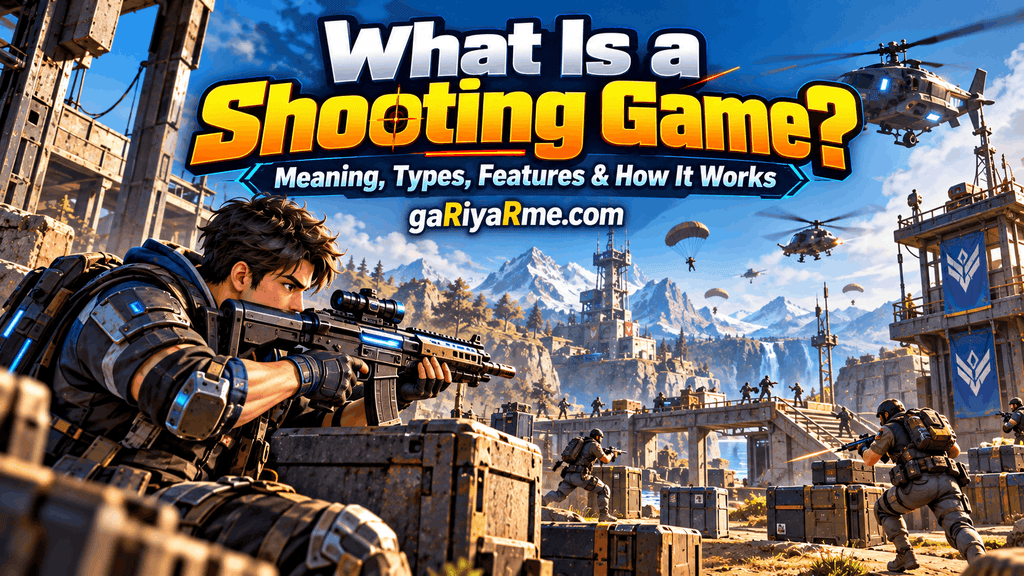
A shooting game is a video game where shooting or ranged combat plays a major role in the gameplay.
The category includes FPS games, third-person shooters, tactical shooters, multiplayer shooters, Battle Royale games, and many other formats.
Understanding shooting games also helps players understand related gaming concepts such as FPS, multiplayer gaming, Battle Royale, weapons, maps, combat systems, and game mechanics.
For gamers, shooting games can provide action, competition, teamwork, strategy, exploration, and replayability.
For game developers, the genre offers a huge range of possibilities for designing unique weapons, characters, maps, combat systems, and multiplayer experiences.
FAQ
What is a shooting game?
A shooting game is a video game where shooting or ranged combat is a major part of the gameplay.
What are the main types of shooting games?
Common types include FPS, third-person shooters, tactical shooters, multiplayer shooters, hero-based shooters, and Battle Royale shooters.
Is FPS the same as a shooting game?
No. FPS is a specific type of shooting game that uses a first-person perspective.
Is Battle Royale a shooting game?
Many Battle Royale games are shooting games, but Battle Royale is a broader gameplay format based on survival and competition.
Can shooting games be single-player?
Yes. Many shooting games offer single-player campaigns, missions, or story modes.
Can shooting games be multiplayer?
Yes. Multiplayer is one of the most popular formats for shooting games.
Are shooting games only about guns?
No. Shooting games can use bows, energy weapons, futuristic weapons, abilities, and other ranged weapons.
Can shooting games be played on mobile?
Yes. Many shooting games are available on smartphones and tablets.
What is a tactical shooting game?
A tactical shooting game emphasizes positioning, teamwork, planning, map knowledge, and strategic combat.
What makes a shooting game good?
Responsive controls, satisfying gunplay, balanced gameplay, interesting maps, meaningful progression, and engaging challenges can all contribute to a good shooting game.
Leave a Reply